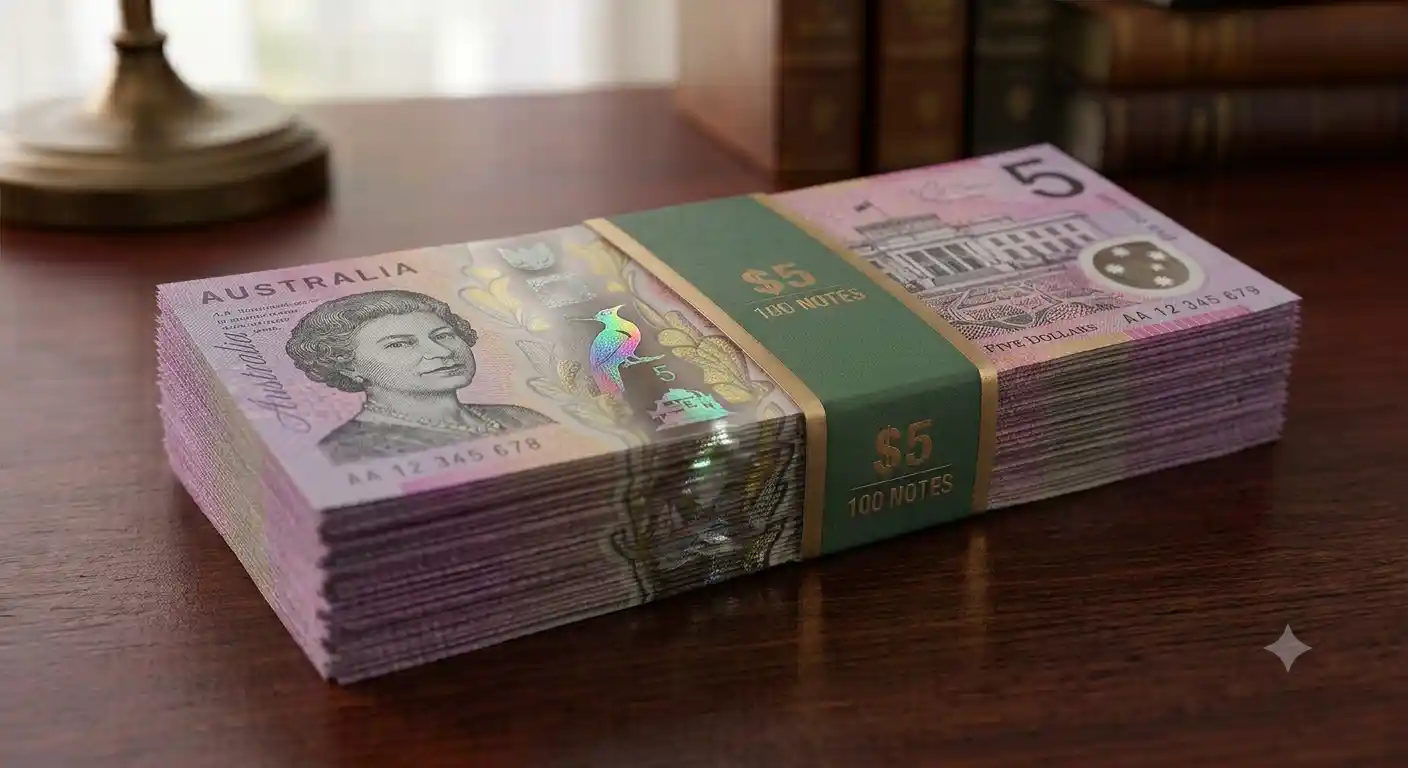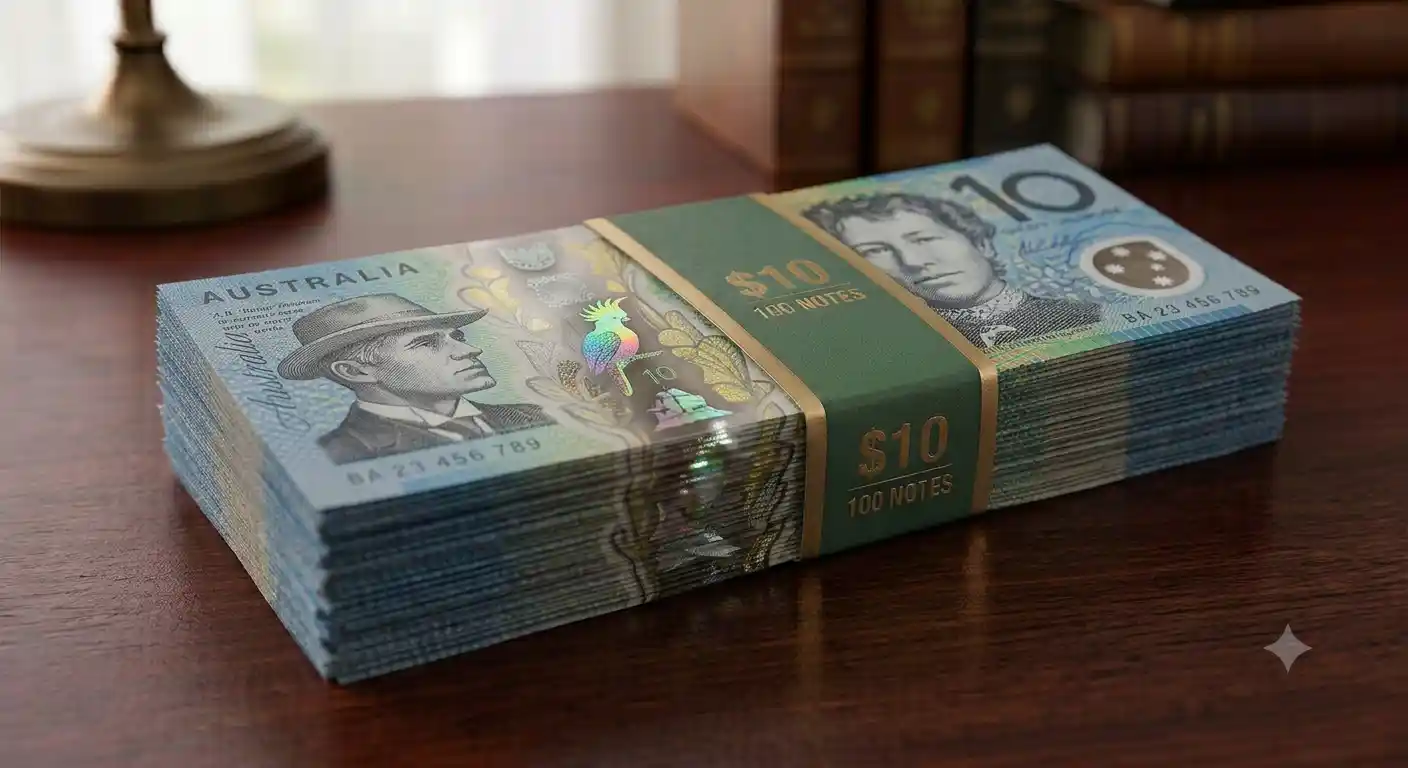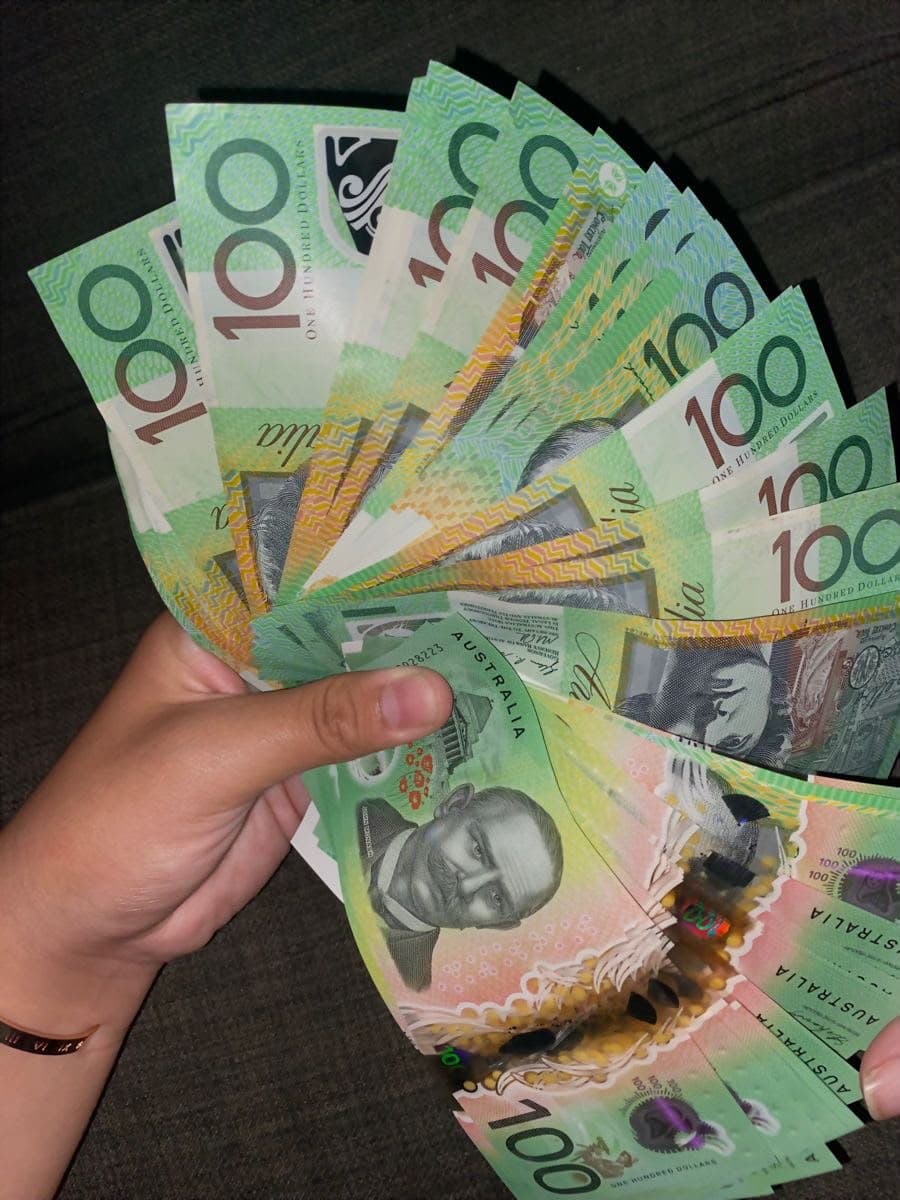
Search for "fake money" in Australia and you will find everything from board game tokens to listings that cross a legal line. The phrase covers too much ground to be useful, and the difference between lawful imitation money for a production and an offence under Commonwealth law is not a matter of taste. This guide explains the vocabulary, the tests that separate prop money from counterfeit currency, and the questions to ask before you buy. It is general information, not legal advice.
Why the words matter
People use "fake money", "imitation money", "play money", "toy money", "prop money", "replica notes" and "counterfeit" as if they were interchangeable. They are not, and a supplier who uses them loosely is telling you something about how careful they are.
- Play money and toy money are obviously not real. They are brightly coloured, different in size and designed for games, classrooms and children. They carry almost no legal risk.
- Prop money is reproduction currency made for motion pictures, television, theatre, photography and training. It is designed to look right on camera while remaining clearly marked and clearly different in the hand.
- Imitation money is the broad everyday term for any of the above. On its own it tells you nothing about legality.
- Counterfeit currency is made or used to deceive. It is a criminal matter, and nothing in this article describes how to make it or where to get it.
The legal line in one paragraph
The Commonwealth Crimes (Currency) Act 1981 protects Australian currency. The law cares about whether an item could deceive a reasonable person into accepting it as genuine, and about what someone does with it. A reproduction with clear, permanent specimen markings, a different material and size or treatment, and honest marketing sits on the lawful side. A note made to pass at a till does not. Our compliance page explains how PROPPS builds to Section 22 and the Reserve Bank's reproduction guidance.
Four tests that separate prop money from counterfeit
Use these four tests on any supplier, including us.
1. Is it marked?
Every note should carry permanent, prominent markings such as SPECIMEN or a statement that it is for motion picture use only. Markings that can be rubbed off, cropped out or hidden in fine print do not count. Ask for a photo of the note's front and back before you order.
2. Is it different from a genuine note?
Real Australian banknotes are printed on polymer and carry layered security features. A prop that is also polymer and copies every feature is not a prop in any sense that matters. PROPPS prints on non-reflective archival paper, which reads correctly on camera and feels different in the hand.
3. Is the marketing honest?
A legitimate seller describes the product as a prop, names the permitted uses and states that it is not legal tender. Warning signs include phrases about passing detection tests, "undetectable" quality, unmarked or discreet delivery, and unsourced claims of government clearance. Honest copy never suggests you can spend the product.
4. Is the intended use legitimate?
Film, television, theatre, advertising, photography, art and simulation training are all clear uses. A "prank" at a restaurant, a social media stunt that presents prop cash as real, or any attempt to pay for something is misuse, whatever the notes were bought for.
Comparing the options
Here is how the common categories line up for a buyer:
- Board game and toy money: safe, but looks wrong on camera and is not made for production use. Our guide to play money vs prop money covers the choice.
- Marked prop currency from a local studio: the right choice for a scene that needs realism and a paper trail.
- Unmarked "realistic" notes from marketplace sellers: the highest risk. They may be held at the border, and a buyer who cannot show specimen markings has nothing to show a police officer or an insurer.
- Anything described as counterfeit or sold to be spent: illegal. Do not buy it.
What this looks like on a real production
A drama set in a bank needs a few hundred $100 notes in the drawer and one hero stack on the counter. The art department orders marked notes from an Australian supplier, files the invoice, stores the notes with the prop master and counts them in and out each shooting day. When a location owner asks what the cash is, the answer is a one-page supplier statement and a note in the call sheet.
A photographer shooting a lifestyle campaign uses a fanned handful of $50 notes. The notes are marked, the shoot is in a studio, and nothing leaves the building. Compare that with a content creator who films themselves handing prop cash to strangers: the notes are identical, but the use is not.
Read more on the creator side in our guide to prop money for content creators and our photography guide.
Questions to ask before you buy
- Are the notes marked, and can I see a photo of the markings?
- Is the supplier an Australian business with an ABN and a physical address?
- What material are the notes printed on?
- How are they delivered, and is a signature required?
- Does the seller state what the notes may and may not be used for?
- Will I get an invoice and a written description I can put on the production file?
Common myths
"If it is clearly a prop, nothing can go wrong." The markings protect you only when they are on the note and you can show them. A prop kept in a wallet, spent or posted as real cash loses the protection that the markings and the invoice give you.
"A disclaimer in the listing is enough." A line of small print on a website does not travel with the note. The marking has to be on the note itself, where anyone who picks it up can read it.
"Overseas notes are the same, only cheaper." They often are not. Polymer notes that copy current Australian designs closely are the category most likely to be stopped at the border, and you will have no local supplier to call if something goes wrong.
"Everyone knows it is a prop on a film set." The crew do. A bank teller, a shopkeeper or a passer-by watching a street shoot does not. Briefing the venue first is part of using prop money responsibly.
"Only big productions need to worry." The rules do not scale with budget. A student short and a feature film both need marked notes, a supplier invoice and a sensible plan for who holds the cash. Smaller crews often have less legal back-up, so a clean paper trail matters more, not less.
Why we avoid the word "fake" on our product pages
Buyers do search for "fake money", and our guides use that phrase where it helps people find accurate information. But we do not describe products as fake, spendable or lookalike cash, because it frames the product as something it is not. Our notes are reproduction props. They are specimen-marked, they are paper rather than polymer, and they are made for the screen, the stage and the classroom.
Where to go next
Browse the New Notes range, read the guide on whether it is illegal to buy prop money, or see the full Section 22 explainer. Orders start at $300 AUD, delivery is free from $500, and every parcel ships Australia Post Express with signature on delivery.
This article is general information, not legal advice. Check the current legislation and the RBA's guidance, and ask your own lawyer about a specific production.