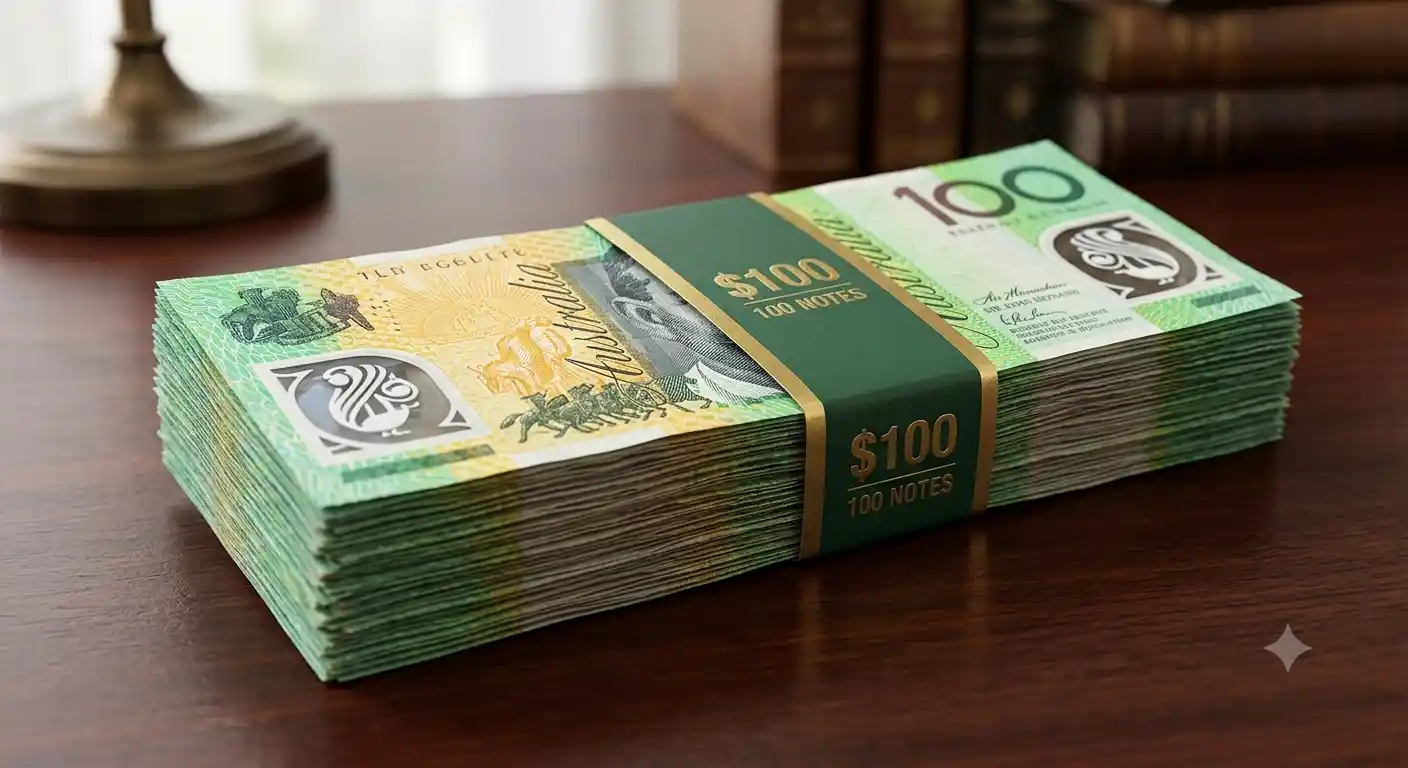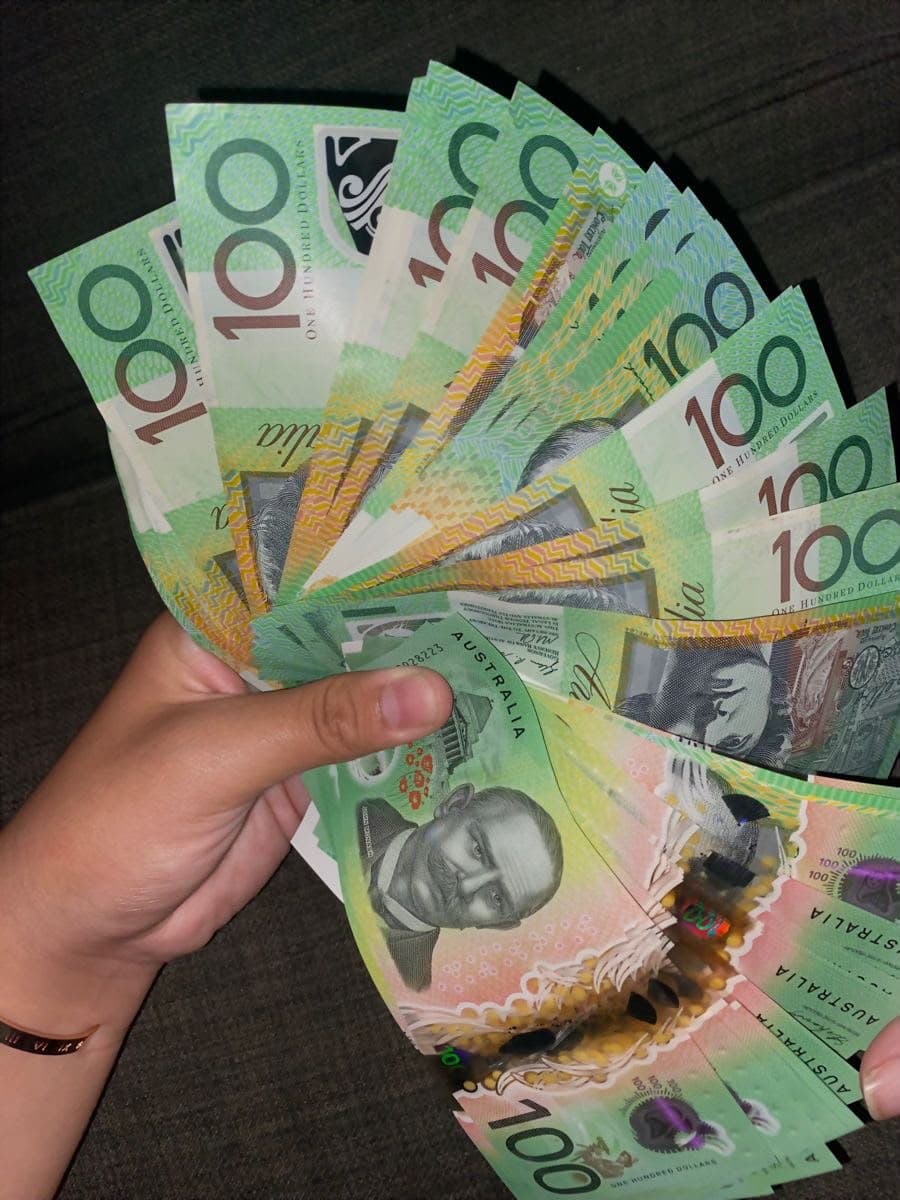
For most Australian productions, 100 dollar prop money does the heavy lifting. The denomination reads clearly on camera, signals value at a glance and holds its colour under both natural and studio light. The harder question is how much to order. Too little and the scene looks thin. Too much and the budget goes on bundles the lens never sees. This guide shows how to pick a bundle size for wallet shots, desk spreads, bag reveals and vault scenes, with the real stack sizes and prices, and a few tricks that let a small order read as a large one. All our notes are specimen-marked, non-legal tender props.
The short answer
Match the stack size to what the camera actually sees. A hand or wallet shot needs a Starter Stack. A desk or table spread needs one or two stacks. A bag or briefcase scene needs five. A vault or heist reveal needs ten or more, and a full bank vault scene is where 50 and 100 stack orders come in. Use hero stacks of $100 notes where the camera is close, and fill the rest of the frame with cheaper material.
The bundle sizes and what they cost
Every product in the New Notes range is sold in the same stack tiers. Stack sizes are described by face value, and prices are in AUD:
- Starter Stack: $1,500 face value, $115
- 1 Stack: $2,000 face value, $200
- 5 Stacks: $10,000 face value, $850
- 10 Stacks: $20,000 face value, $1,600
- 50 Stacks: $100,000 face value, $7,500
- 100 Stacks: $200,000 face value, $14,000
Orders start at $300 AUD, so a Starter Stack on its own does not clear the minimum. A Starter Stack plus a 1 Stack, or a single 5 Stacks order, is the usual way to start. Delivery is free from $500 AUD, and payments in cryptocurrency receive a 10% discount. You can see the current prices on the $100 product page.
Match the bundle to the shot
Wallet or hand shot
A close shot of a hand counting notes or a wallet opening only shows a few notes. One Starter Stack covers it, with plenty left over for continuity. Spend the saved budget on a clean, uncreased hero note that you keep for the close-up.
Table spread or desk scene
A pile on a table, a desk or a car bonnet needs volume without depth. One or two stacks give a natural-looking spread. Let the notes fall loosely and vary the angles. A neat grid looks staged.
Bag, briefcase or handover
A handover scene shows a bag opening and a thick bundle at the top. Five stacks usually fill a briefcase to the lip. Put $100 notes on top of the bundles that show, and place filler underneath. If the scene shows the same bag twice, order enough matching stacks so you are not rebuilding them between set-ups.
Heist or vault reveal
A vault, a safe or a cash room is where the camera pulls back. This is where 10 stacks and above come in. Count the shelves, the pallets and the bags in the frame, then work out how many bundles each one holds. For the biggest scenes our Money Stacks category and wholesale page are the right place to start. Our guide to prop cash for heist and bank scenes goes through the maths in detail.
Make a small order look big
Art departments rarely buy a full vault of hero notes. These are the usual tricks:
- Hero on top, filler underneath. The camera sees the top note and the stack edges. Put $100 notes at the visible faces and cheaper material behind them.
- Fan the notes. A fanned handful reads as a thicker stack than a flat one.
- Vary the denominations. An all-$100 drawer looks wrong. Mix in $50 and $20 notes, as our guide to the best Australian banknote denominations for film and TV explains.
- Use depth of field. A shallow focus blurs bundles in the background, so you do not need hero quality there.
- Break the line. Open a strap, spill a few notes and leave one stack at an angle. Perfect order looks fake.
- Keep spares. Hold one stack unopened as a reserve for late changes.
Continuity and re-takes
Continuity is the quiet cost of a cash scene. If the same money appears before and after a handover, you need matching stacks for both sides of the cut. Notes are double-sided, so a flipped stack still looks right. Order the full quantity for a block of shooting in one go, so the notes in scene 12 match the notes in scene 3. If you need a repeat order, contact the studio and mention the earlier order.
Worked examples
These three examples show how the same tiers stretch across different scenes. Quantities are a starting point. Always count what your own shot list shows.
A bank counter scene
The camera starts on a teller counting a bundle, then cuts to a wide of the counter with a few stacks. One 5 Stacks order covers the hero stacks, the teller's drawer and a reserve. Put $100 and $50 notes on the visible faces of the bundles and use $20 and $10 notes in the drawer. Total: $850, which also clears the order minimum and delivery threshold.
A kitchen-table handover
A character slides a bundle across a table, and the camera holds on the money for two seconds. One stack in a close-up is enough, and a Starter Stack plus a 1 Stack ($315 together) clears the minimum with room for a second take and a reserve. If the scene is shot twice from different angles, the second stack lets the art department reset instantly without rebuilding the first.
A vault reveal
A heist or security scene pulls back to show shelves of bundles. A 10 Stacks order ($1,600) fills a modest vault. A larger set with pallets and open bags suits 50 Stacks ($7,500). A full cash room is where 100 Stacks ($14,000) and a wholesale conversation make sense. In every case, put hero stacks at the front and let depth of field handle the back.
Common mistakes with bundle sizes
- Ordering for the whole frame instead of the visible faces. The camera sees the top of a stack, not its core.
- Forgetting the second set-up. Matching stacks for a second angle save more time than they cost.
- Buying only $100 notes. A drawer or wallet with a single denomination looks staged.
- No reserve. A single unopened stack is cheaper than a rush order on the morning of the shoot.
- Leaving it late. Express dispatch is fast, but it needs someone at the address to sign.
Why $100 notes dominate screen work
The Reserve Bank's current $100 note is a strong, saturated green that reads on camera under most lighting, and the denomination signals value instantly. That is why productions lean on $100 and $50 notes for hero stacks and use $20, $10 and $5 notes for tills, wallets and counters. If you are choosing between denominations, read our guide to the $50 and $100 range and browse the $50 product alongside the $100.
Compliance and handling
Every note carries permanent specimen markings, and every product is a non-legal tender reproduction made for motion pictures, television, theatre, visual arts and simulation training. Keep the notes with the prop master, count them in and out each day, keep the invoice on file and never spend them or hand them out. For the legal background read our Section 22 guide and visit the compliance page. The Reserve Bank publishes its own guidance on banknote reproductions.
Where to go next
Start with the $100 prop notes, compare the Money Stacks, or read how much prop money you need for a scene if you are still sizing the order.