Australian banknotes are a visual language. The colours, the sizes and the stacks tell an audience at a glance whether a character is rich or struggling, whether a scene is a legitimate sale or a back-alley deal, and whether the money is a lot or a little. Choosing the right denominations for a scene is one of the quiet decisions an art department makes, and it affects how believable the cash looks. This guide explains the five current Australian denominations, how each reads on camera, which to use for hero stacks, tills and wallets, how to mix them, and how to order the right quantity. All PROPPS notes are specimen-marked, non-legal tender props printed on matte paper, never polymer.
The short answer
Use $100 and $50 notes for hero stacks and close-ups, because their colours read strongly on camera and signal value at a glance. Use $20, $10 and $5 notes for tills, wallets, tips and everyday purchases, where an all-$100 drawer would look staged. Most scenes use two or three denominations rather than one, and a believable cash scene always mixes them.
The five current denominations at a glance
The Reserve Bank of Australia issues five banknotes in the current series, each with its own colour and design. This summary describes how they work on screen, not how to identify genuine notes.
- $5 note. The smallest note, used for tips, coffee, newspapers and small change. Its pinkish-purple tone reads softly and sits naturally in a pocket.
- $10 note. A blue-toned note that suits small purchases, lunches and pocket money.
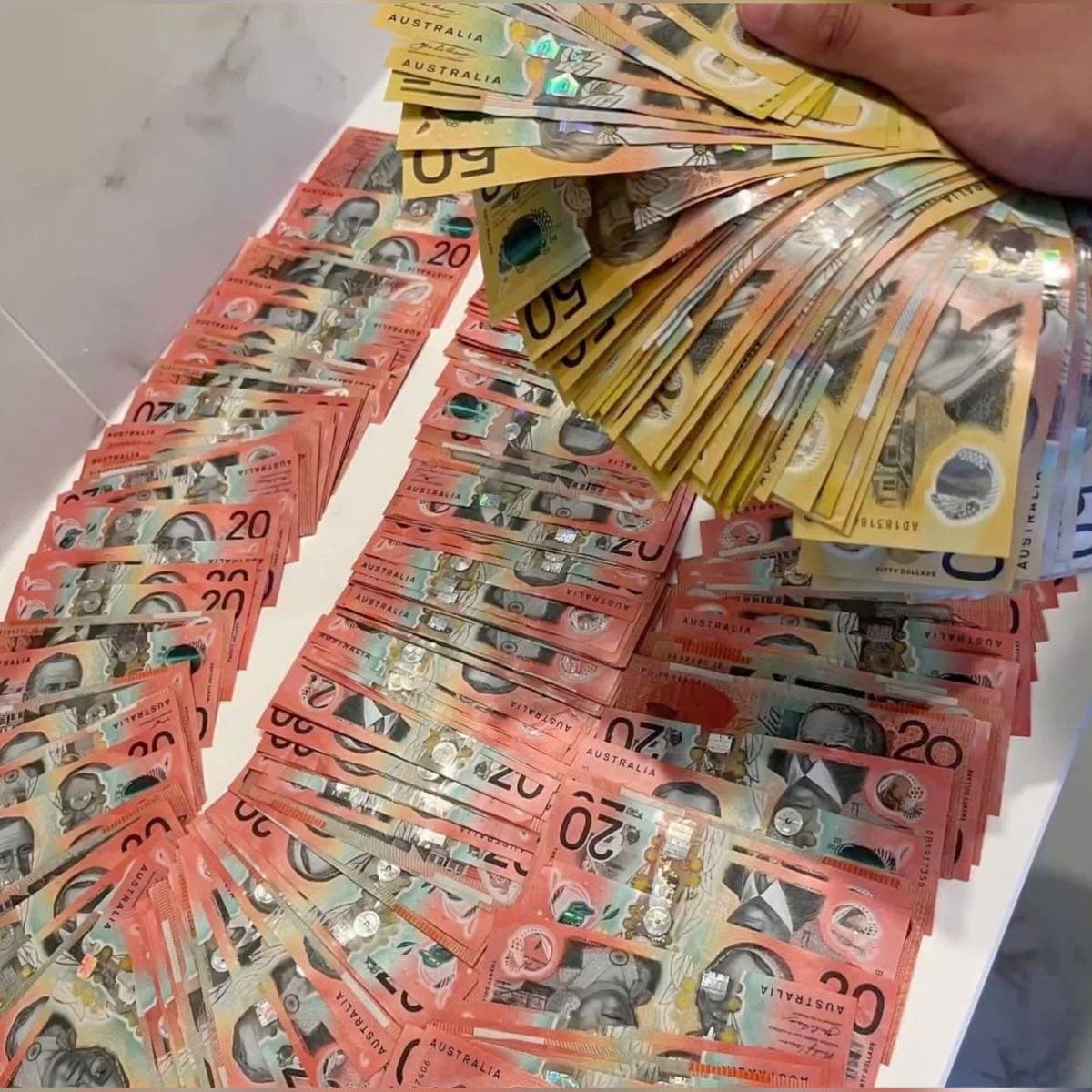
- $20 note. A red-orange note, the everyday workhorse in wallets, till drawers and ATM scenes.
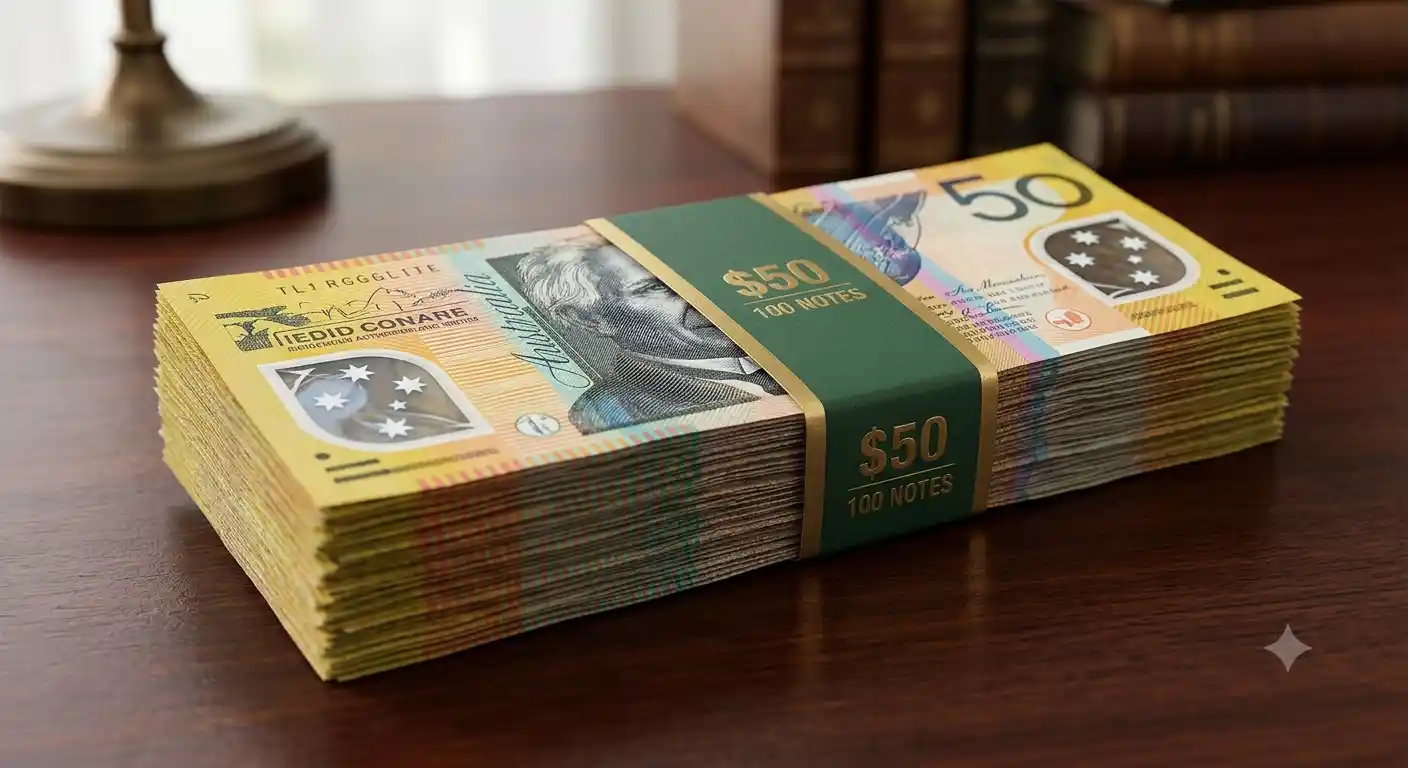
- $50 note. A gold and yellow note that carries weight on camera and suits bigger purchases, bills and payments.
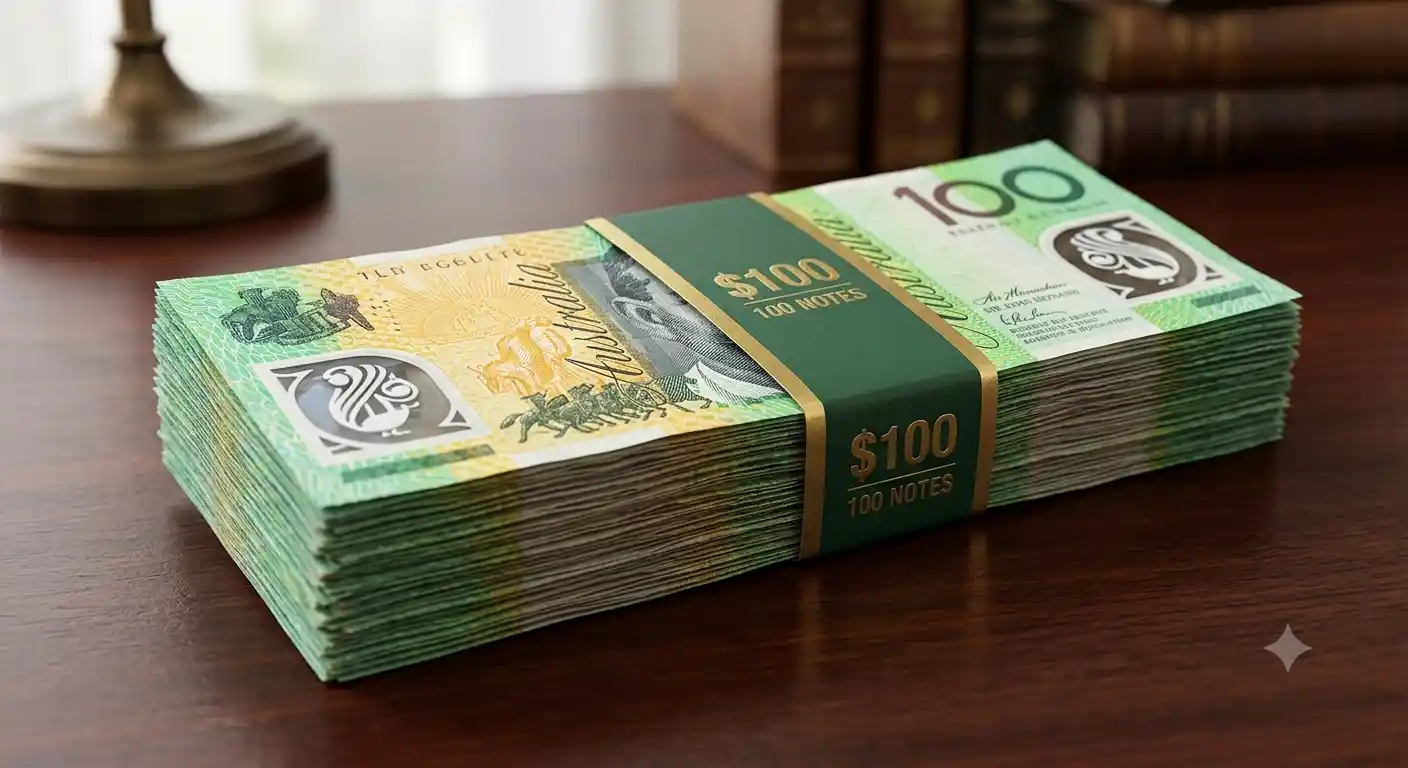
- $100 note. A green note that signals real money. It is the denomination most associated with bundles, heists and big payments.
Colours vary slightly under different light, so check them on the monitor. Our guide to lighting prop money on camera explains how to keep them accurate.
How each denomination reads on camera
$100 notes
The $100 note is the star of a cash scene. A stack of green reads clearly at a distance and under most lighting. It suits briefcases, tables, vaults and handovers. The risk is overuse: a drawer or wallet of only $100 notes looks like a prop department made it. See the $100 product, and our guide to $100 bundle sizes.
$50 notes
The $50 note's gold reads warmly and gives a stack a rich look. It works well as the top layer of a bundle with lower denominations beneath, and in bills, bribes and payments. See the $50 product.
$20 notes
The $20 note is the everyday note. It belongs in wallets, till drawers and ATM scenes. A handful of $20 notes reads as ordinary money, which makes a scene feel real. See the $20 product.
$10 notes
Tens suit small purchases, lunch money and tips. They add variety in a till and a sense of realism in a wallet. See the $10 product.
$5 notes
Fives are for tips, small change and children's pocket money. A few in a wallet or a tip jar completes the picture. See the $5 product.
Mixing denominations by scene
Here are common scenes and a sensible mix.
- A bank counter: strapped bundles of $100 and $50 on the counter, with $20 and $10 notes in the teller's drawer.
- A shop till: a mix of $50, $20, $10 and $5 notes in the tray, with a few $100 notes under the tray.
- A wallet or handbag: two or three $20 notes, a $10 and a $5, with one $50 for variety.
- A briefcase or handover: $100 and $50 on the visible faces, with filler beneath.
- A vault or cash room: $100 stacks in the foreground, with a mix behind.
- A kitchen table or bedroom stash: a loose mix of $50, $20 and $10, creased and unevenly stacked.
- A tip jar or busker's hat: $5, $10 and a few coins.
Realism tips
- Match the character. A character who carries $20s is a different person from one who carries $100s.
- Weather the everyday notes. Small notes are handled more. Our art department guide shows how.
- Use strapped stacks for banks and criminals. Loose notes suggest someone who spends cash daily.
- Do not match the stack too neatly. Real money is slightly irregular.
- Keep the same notes for the same story. If money appears before and after a handover, match the stacks.
Planning quantities
The right quantity depends on what the camera sees. A wallet needs a few notes. A till needs a handful of each denomination. A vault needs stacks. Our how much prop money guide explains the method, and the stack tiers run from a Starter Stack at $115 to 100 Stacks at $14,000. Orders start at $300 AUD and delivery is free from $500 AUD, with a 10% discount for crypto payments.
Period and international notes
Productions set in earlier decades sometimes need older note designs, which have different colours and sizes. If your story is set in the past, tell the art department early, and read our history of Australian currency notes for set designers. Productions shooting overseas stories may need other currencies, which PROPPS does not currently supply. We make Australian dollar props only.
Compliance
Every PROPPS note carries permanent specimen markings, is printed on matte paper rather than polymer and is sold as a non-legal tender reproduction for motion pictures, television, theatre, visual arts and simulation training. Never spend them, and keep them under the prop master's control. Read our Section 22 guide and the compliance page for the full standard.
Reading a denomination mix from the script
Start with the character. A student with a part-time job carries a few $20 notes and some coins. A tradesperson paid in cash carries a roll of $50s and $20s. A bank manager has crisp, strapped bundles. A small-time crook has a mix of everything, crumpled and folded. A retail worker has a till of small notes and a bag of coins. When the script says "he pays", ask what he is paying for. A coffee is a $5 or a $10. A used car is a bundle of $100s. The denomination is part of the story.
Denominations and the size of the sum
Audiences judge the size of a sum by the size of the stack and the colour on top. A thin stack of $100s reads as a few thousand dollars. A thick stack of $20s reads as the same sum but looks a little desperate. If a scene needs to feel like a lot of money in a small space, use $100s. If it needs to feel like money scraped together, use $20s and $10s. Our $100 bundle size guide shows how many stacks the camera needs.
Mixing mistakes to avoid
- All one denomination. A till or a wallet of only $100 notes looks staged.
- Too many large notes in everyday scenes. A shop till rarely holds many $100s.
- Uniform wear. Real notes in the same wallet have different ages.
- Ignoring colour in the grade. If the grade desaturates greens, a $100 stack may lose its punch. Check the notes in the grade, not only on set.
- Forgetting continuity. If a character pays with a $50 and receives change, the notes on screen should add up.
Ordering by denomination
Each denomination is a separate product in the New Notes range, and the stack tiers are the same across all five. For a typical drama, order the hero denominations in the larger tiers and the small ones in a Starter Stack. A single order combining several denominations also helps reach the $300 minimum and the $500 free delivery threshold. If you are unsure about the mix, send the scene list through the contact page and we will suggest one.
Small details that sell the cash
Rubber bands, paper clips and folded receipts make a bundle look like it belongs to a person. A $5 note folded in half in a back pocket tells a different story from the same note flat in a wallet. Think about how the money is carried, not just what it is.
Where to go next
Browse the New Notes range, compare the individual denominations above or contact the studio with your scene list.